
Disclaimer: The following is an independent review of an original article. The link to the original article can be found at the end of the review section below.
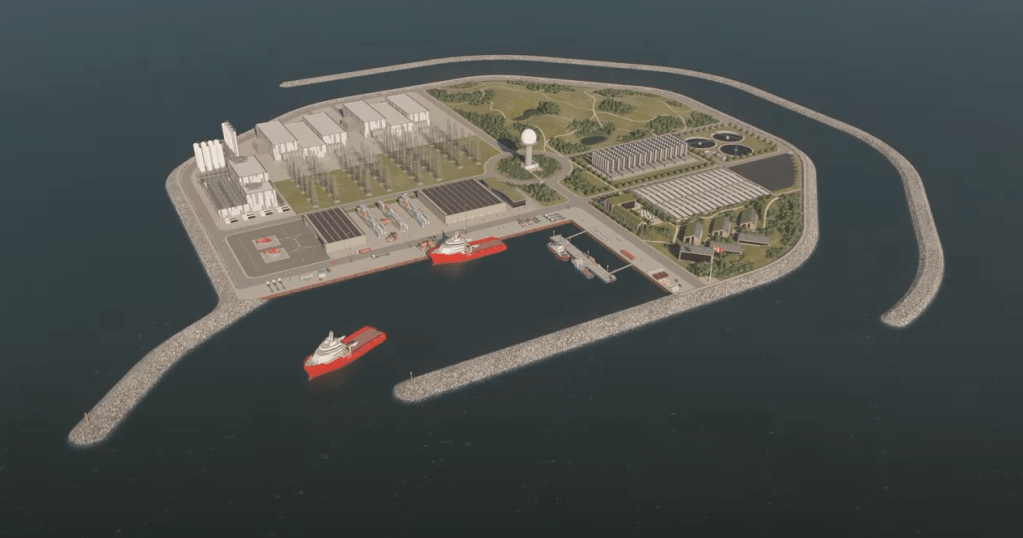
In the foreseeable future, there exists the potential for governments and corporations to transcend local geographical constraints and establish expansive power stations in the midst of oceans. With each country facing limitations on available land, especially for large-scale utility projects, the concept involves the creation of islands powered by diverse renewable energy sources such as offshore wind, solar, and tidal energy. The strategic placement of these islands offers access to optimal renewable resources. The generated energy can be transmitted onshore or utilized for processes like electrolysis, producing green hydrogen and subsequently manufacturing other e-fuels like green ammonia. From a technical standpoint, this vision appears feasible, yet its realization requires further years to refine the concept and develop the essential infrastructure, ensuring both financial viability and practicality. Envisaging a future where seas and oceans host artificial fueling stations, supplying energy to inland regions, and vessels procuring fuels at market prices, this innovative concept holds promise for the next decade and beyond.
I would love to hear your thoughts on this subject! Feel free to share your comments below.
Link to the full article in LINK.
Article in a Nutshell: Key Takeaways
The Danish government’s Climate Action Plan 2020 includes the development of two energy islands, one in the North Sea and one in the Baltic Sea, to export renewable energy and produce green fuels. The larger North Sea island, known as VindØ, is a step closer to realization, with the VindØ consortium, comprising Danish pension funds PFA, PensionDanmark, and utility Andel, envisioning the world’s first energy island. Positioned 100 km off the coast of Denmark, VindØ aims to have a 3 GW offshore wind capacity by 2030, eventually connecting 10 GW. A recent cost-benefit analysis by consulting group COWI estimates the island’s construction cost at EUR 7.93 billion for 3 GW, regardless of whether it is a steel platform or embankment. However, the connection of the intended 10 GW shows a price difference, with an embankment solution being cheaper at EUR 28.22 billion compared to nearly EUR 29.57 billion for a platform. While the construction method is still under discussion, the Bornholm Energy Island in the Baltic Sea is planned to use the existing island of Bornholm as a power hub, and an agreement between German 50Hertz and Danish Energinet signals the first breakthrough for connecting the two Danish energy islands to other countries. The overall goal is to establish the two energy islands and connect 5-6 GW by 2030, crucial for a successful green transition, with Ørsted and PensionDanmark suggesting that the islands could be constructed earlier.
 The Watt Studio
Leave a comment