

Residential solar photovoltaic (PV) systems represent a significant advancement in household energy solutions in the United States, providing homeowners with a sustainable and economical alternative to traditional electricity sources. These systems convert sunlight directly into electricity, reducing reliance on fossil fuels and decreasing household carbon footprints. Additionally, solar power can significantly reduce electricity bills and increase property values, making it an attractive investment for homeowners.

Exploring Solar Incentives: A State-Dependent Benefit
Investing in solar technology is supported by a variety of tax incentives which vary by state but can significantly reduce the upfront costs associated with solar installations. Understanding these incentives can make solar installations much more affordable.
- Federal Solar Tax Credit (ITC): Homeowners can deduct 30% of the cost of installing a solar energy system from their federal taxes, significantly reducing the installation cost.
- State Tax Credits: Many states offer additional tax credits, reducing costs further depending on the homeowner’s location.
- Rebates from Electric Utilities: Rebates are partial refunds provided by some utilities for installing solar systems, which can lower upfront costs directly.
- Net Metering: Allows solar system owners to sell excess electricity back to the grid, effectively reducing their electricity bills or even earning money.
- Payments for Renewable Energy Certificates (RECs): Homeowners can earn and sell RECs generated by their solar systems for additional income.
- State Government Rebates: Some states offer direct rebates which can be combined with other incentives to further reduce the costs of solar systems.
- Local Incentives and Additional Rebates: Various localities offer additional incentives such as property tax exemptions, sales tax exemptions, and more. These incentives vary widely but can provide significant additional savings.
For a comprehensive list of incentives by state, visit Unbound Solar’s State Solar Incentives.
Case Study: Financial Analysis of a Typical US Home Residential Solar System

Let us consider a case study of a house in the US, where the owner is considering adding a solar system on their rooftop. The home is currently connected to the grid and gets all of its electricity requirements from the utility company. The home currently consumes an average of 12,000 kWh a year, at an average utility rate cost of 17 cents/kWh.
System Specifications and Energy Production
- System Size: 20 modules rated at 450W each, totaling 9 kWp.
- Energy Generation: Assuming the home is situated in a location where the solar generating capacity factor is around 15%, the system annually generates approximately 11,826 kWh. This is calculated using the formula:
Annual Generation = DC Capacity x Capacity Factor x Days in a Year x Hours in a Day
Annual Generation = 9,000 x 0.15 x 365 x 24
Financial Evaluation: Costs and Incentives
- Installation Cost: $31,500 (9 kWp system at $3.5/W).
- Federal Tax Credit: Reduces the cost by $9,450 (30% of $31,500), netting $22,050.
- Financing: A 10-year loan at a 6% interest rate results in annual payments of about $2,996.
Financial Evaluation: Savings
- Utility Cost Savings: Starting at an average rate of 17 cents per kWh with an annual increase of 3%, projected savings over 25 years total approximately $33,658.
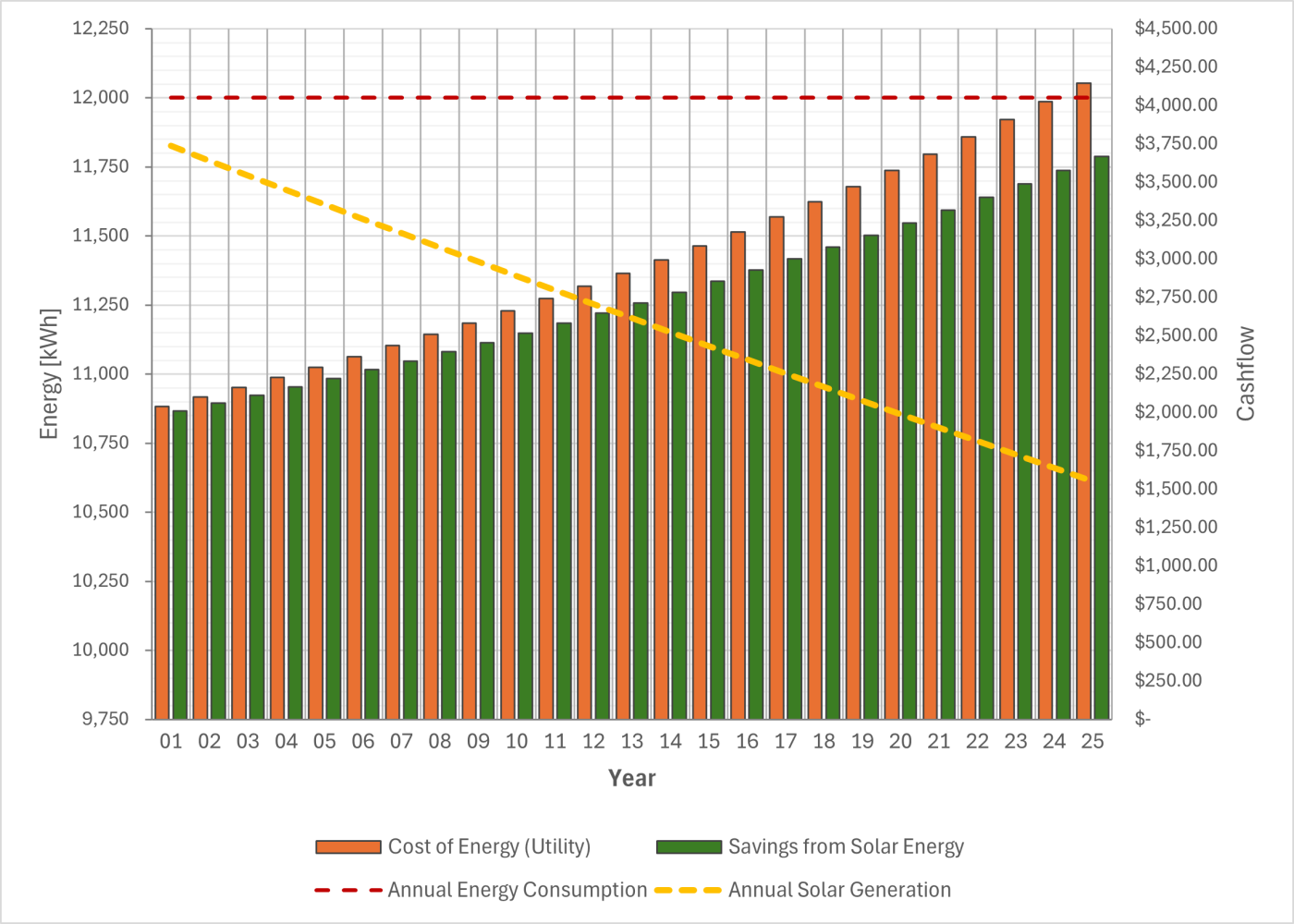
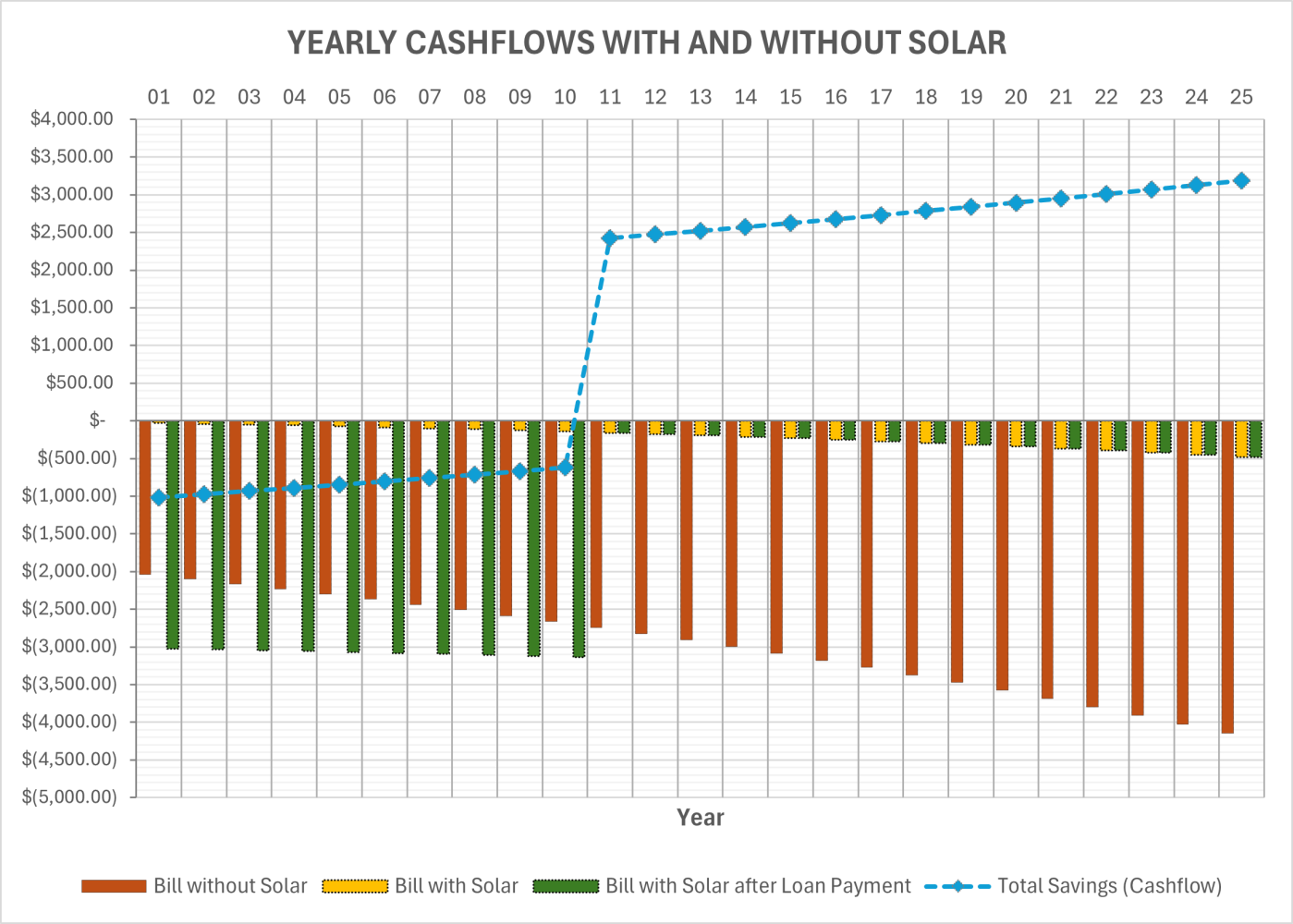
- Net Present Value (NPV): $17,430 at a 3% discount rate, representing the value of future net savings today.
- Internal Rate of Return (IRR): The project yields an IRR of approximately 14%, indicating a strong return on investment over the project’s lifetime.
Disclaimers:
- Operation and maintenance costs for residential solar systems are generally minimal. Much of the maintenance involves routine cleaning of the solar modules approximately once a month to ensure optimal performance.
- Bank loans might usually have variable interest rates that change or increase as time goes by. A good rule is to naturally go for as short a loan term as possible to guarantee the lowest interest rate applying to the loan you are going to take.
- Naturally, if additional incentives apply to your specific case, your savings and cash flow will improve, as well as your monthly or yearly repayment schedule. The project’s final total savings, net present savings, and IRR will consequently improve.
- If the solar system output is larger than the total home consumption, the owner can usually make use of net metering incentives, where the utility company will pay them for the excess energy they are injecting into the grid (that will vary by state as each utility company has their own net metering rules).
- A good website to check the solar capacity factors for your home system is Lawrence Berkeley National Laboratory’s Solar Capacity Factors Site.
Key Takeaway
This case study underscores the economic viability and environmental benefits of installing a residential solar system. The detailed breakdown of costs, savings, and incentives highlights how solar power not only contributes to sustainability but also offers significant financial returns. Homeowners can leverage federal and state incentives, along with financing options, to make solar energy a profitable and wise investment. By understanding the intricacies of solar installation and financial benefits, homeowners are well-equipped to make informed decisions about adopting this clean energy solution.
 The Watt Studio
Leave a comment